
Executive Leadership Retreats
Days away from the business that change how a leader leads once they are back in it. Here is what separates one from an offsite, how the return is measured, and which of the two programs fits.
What Is an Executive Leadership Retreat?
An executive leadership retreat is a structured, multi-day working session, run by an outside coach, that takes senior leaders out of daily operations and puts the conversations they have been deferring at the center of the agenda.
The definition matters because the category is crowded. In our experience most retreats sold under a leadership label are one of three things: a strategic planning offsite with a nicer view, a team building exercise, or a wellness retreat with a leadership label attached. Each has a use. None of them changes how a senior leader leads once they are back in the office.
Executive leadership retreats at John Mattone Global are built on a different premise. Leaders are developed from the inside out, through reflection, evidence, and a plan that names what each individual has to change. The break from daily operations is the enabling condition, not the product.
Why John Mattone Global Executive Coaching?
At John Mattone Global, we don't just promise growth. We deliver measurable leadership transformation that drives success across individuals and organizations.
Unlock Potential
Develop leaders from the inside out with a proven focus on inner-core strength (character, emotional intelligence) and outer-core excellence (skills, execution).
Achieve Real Results
Through tools like LeaderWatch®, we track quantifiable progress in leadership competencies with measurable ROI.
Build Lasting Networks
Connect with like-minded executives and high-achievers who become lifelong peers, mentors, and collaborators.
Transform From Within
Our retreats go beyond surface-level skills to address the inner-core foundations that drive lasting leadership change.
LeaderWatch® Reporting: Proven Results
Rated by the people who work with them, as a percentage of the maximum possible improvement, across 788 development goals in the 2026 dataset.
Overall Improvement
Gains in Sensitivity & Empathy
Growth as Culture Architect
Visionary & Strategic Leadership
Two Programs, Two Different Commitments
The choice is not really about length. It is whether the peer group is the week or the year, because that decides how much of the change happens after everyone goes home.
Two and a half days
The Intelligent Leadership 2.5-Day Executive Retreat
High potential and established leaders build their own framework for leadership, working from their own assessment data rather than from a template. Based on John's global best-sellers.
- MLEI® assessment and a private debrief before arrival
- An Individual Leadership Development Plan each leader owns
- LeaderWatch® re-measurement at ninety days
One year
The John Mattone Legacy Circle™
For CEOs, C-level leaders, and founders who want the peer group to become part of the year, not simply part of a week. A private, year-long experience for a limited cohort of accomplished leaders, built around four intimate summits with John Mattone and the relationships, conversations, and accountability that continue between them.
- Four private summits with John across the year
- A carefully selected cohort of CEOs and founders
- Meaningful peer relationships that deepen over time
- Membership: $35,000 annually, by application
How Our Retreats Differ From a Standard Offsite
The retreats we are asked to compete against are built around activities. Ours is built around evidence.
A standard offsite opens with introductions, runs a sequence of workshops and group discussions, adds outdoor activities or team building activities in the afternoon, and closes with a list of intentions nobody owns. Participants leave energized. Six weeks later the team dynamics are exactly what they were. The new ideas were real. Nothing in the design carried them back into the company culture that produced the problem in the first place.
Assessment before agenda
A standard offsite is designed from a template and a slot count, then populated with whoever attends. Ours is designed after the assessments come back, which is why two retreats with the same title run differently.
Inner core on the agenda
Most retreats work on behavior, because behavior is easier to run an exercise about. Behavior that is not anchored in character reverts the moment pressure returns. Leadership styles and communication patterns are downstream of something the agenda has to actually reach.
Everyone leaves with a written plan
Not a shared vision poster, and not a list of intentions with no owner. The difference is enforceability: a commitment with a name and a date against it can be reviewed, and one without either cannot.
Problem solving happens against this team's actual constraints rather than a case study, and the agenda is tailored to them. Leaders do get pushed outside their comfort zones. That is a consequence of the work, not the point of it.
A Few of JMG's Executive Coaching Clients





How We Help Leaders & Organizations Thrive
For Leaders:
- •Sharpen self-awareness and emotional intelligence
- •Develop strategic thinking and decision-making skills
- •Build executive presence and influence
- •Work through complex organizational dynamics
- •Achieve work-life integration and sustained performance
For Organizations:
- •Develop high-potential leadership pipeline
- •Improve team alignment and collaboration
- •Drive cultural transformation
- •Accelerate executive onboarding success
- •Achieve measurable ROI on leadership development
What Happens Inside an Executive Leadership Retreat
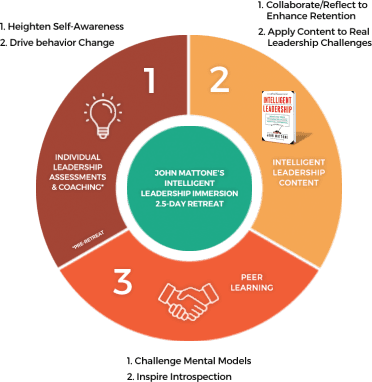
Leaders arrive carrying the same unspoken tensions they have carried for years, whether they come as individuals or as an intact team. The days are built to surface those tensions in a room where they can be worked, and to send each leader home with something written down.
Every participant completes the MLEI and debriefs it one to one with their coach, so nobody arrives cold to their own data.
The leadership success roadmap, the inner and outer core, and the Map of Executive Maturity, gauging where each leader actually sits.
Peer work on each leader’s own story and their MLEI results, then the least mature trait. Homework is a first draft of the development plan.
Plan presentations, accountability shared with key stakeholders, and a LeaderWatch re-measure three months later.
The full agenda, session by session sits on the retreat's own page, along with what each assessment covers.
How to Measure ROI From a Leadership Retreat
Every sponsor should ask how they will know it worked. Most retreat providers answer badly.
Not by self-rating. A leader who has just spent two and a half days being told they have potential rates themselves higher on the way home. That is a mood. LeaderWatch ® asks the people who work with them instead.
- Who rates
- Managers, peers, direct reports and customers. Anonymously, and only on behaviours they actually observed.
- On what scale
- Minus three to plus three, looking back over the previous three months. A negative score is available, which is what makes an improvement mean something.
- When
- A baseline before the retreat, then a re-measure with three key stakeholders at three months.
Pair that stakeholder-observed movement with objectives the business already tracks:
- •Retention on the teams reporting to each leader in the room
- •Time-to-decision on the calls that used to stall
- •Internal promotion readiness for critical roles
- •Employee engagement scores within each leader's span
Set the baseline before the retreat. Read it again at ninety days and at twelve months. Commitments made in the room are worth only the follow-through behind them, and that shows up in these numbers or it does not exist. Measurable results over that horizon are what separate a retreat from an expense, and long term success from a good week.
Is a Retreat the Right Instrument for Your Leadership Team?
The question worth asking first is not how long the retreat runs. It is whether the unit of change is the leader or the team, because that decides what the days in the room are spent on.
A retreat earns its place when a leader wants their own framework rather than a team intervention. High potential and established leaders work alongside a small peer group, each with their own assessment, their own development plan, and a private session with John. Teams do attend together, and when they do the shared evidence is what closes the alignment gaps that strategic planning sessions keep failing to close.
The retreat is tailored to the group in the room, and John's expertise is aimed where it changes the most. Location and setting are chosen to hold attention, not to impress. The strongest signal that a program is serious is what sits on the retreat agenda, not where it is held.
Executive Retreat FAQs
What do you do at a leadership retreat?
Assessment and a private debrief before arrival, then two and a half days moving from diagnosis to honest dialogue to a written plan each leader owns. The summary below sets out the shape; the retreat’s own page carries the full agenda.
How long should an executive leadership retreat be?
Two and a half days is the shortest span we have found that moves a group through diagnosis, honest dialogue, and planning without cutting one of the three short. Shorter formats tend to reach the honest conversation on the final afternoon, with no time left to turn it into commitments.
What is the difference between a team building retreat and a leadership development retreat?
A team building retreat works on how a group feels about each other. A leadership development retreat works on how each leader leads, with the team as the setting. The first improves the mood in the room. The second changes what happens in the office afterward, which is why it can be measured and the first usually cannot.
What happens after the retreat?
The individual development plans are the handover. Each leader owns a small number of dated commitments tied to team goals the business already tracks, and LeaderWatch re-measures at ninety days. The leadership skills worked on in the room only convert into resilience under real pressure if they are practiced where the pressure actually is.
Ready to Transform Your Leadership?
Schedule a complimentary consultation to work out which of the two programs fits your leadership journey, and whether a retreat is the right instrument at all.